
Recommended Original Size and Weight
This section describes the sizes and weights of originals that can be placed, and missing image area.
The following regular original sizes are detected automatically:
 (mainly Europe and Asia)
Original size | Original weight |
|---|---|
A0 Maximum width that can be fed: 960 mm Maximum size: Width 914 × Length 33000 mm Minimum size: Width 210 × Length 210 mm (including B1 JIS*1 | 64–190 g/m2 (17–51 lb.) and 0.090–0.2 mm thick originals |
 –A4
–A4 )
)*1 JIS: Japanese Industrial Standard
*2 ISO: International Organization for Standardization
 (mainly North America)
Original size | Original weight |
|---|---|
Maximum width that can be fed: 37.8 inches Maximum size: Width 36.0 × Length 1299.2 inches Minimum size: Width 8.3 × Length 8.3 inches | 64–190 g/m2 (17–51 lb.) and 0.004–0.008 inches thick originals |
If the originals are curled, use the carrier sheet or flatten the originals so that both their leading and trailing edges fit within the range shown below:
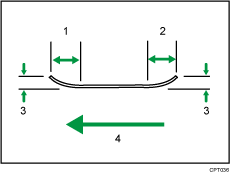
Front curl: R 50 mm (2.0 inches) or more
Back curl: R 50 mm (2.0 inches) or more
Height: 20 mm (0.8 inches) or less
Original feed direction
Originals that should be scanned using the carrier sheet
The following types of originals should be mounted on the carrier sheet. You should also use the carrier sheet for important originals and for originals you will scan repeatedly.
Stacked originals
Originals with fold lines
Wrinkled or torn originals
Waved originals
Punched originals
Originals with adhesive tape, glue or paste stuck to them
Pasted originals
Originals with a damaged leading edge
Originals with surfaces that attach to glass easily such as photographs
Originals drawn in pencil
Originals whose thickness is 0.070 mm (0.003 inches) or less
Non-compatible originals
The following types of originals can cause jams, or may itself be damaged:
Stapled or clipped originals
Perforated or torn originals
Curled, folded, or creased originals
Originals with any kind of coating, such as thermal fax paper, art paper, aluminum foil, carbon paper, or conductive paper
Originals with indexes, tags, or other projecting parts
Thin and soft originals such as translucent (vellum) paper
Bound originals such as books
Damp originals
Originals that vary in thickness
Originals with thick leading edges
Originals with wet ink or correction fluid
Carbon-backed originals
Originals not made of paper (such as glass, metal)
Originals with a roll diameter smaller than 300 mm (11.9 inches)